|
The Center has the biggest and the most complete databases pertinent to the public sector.
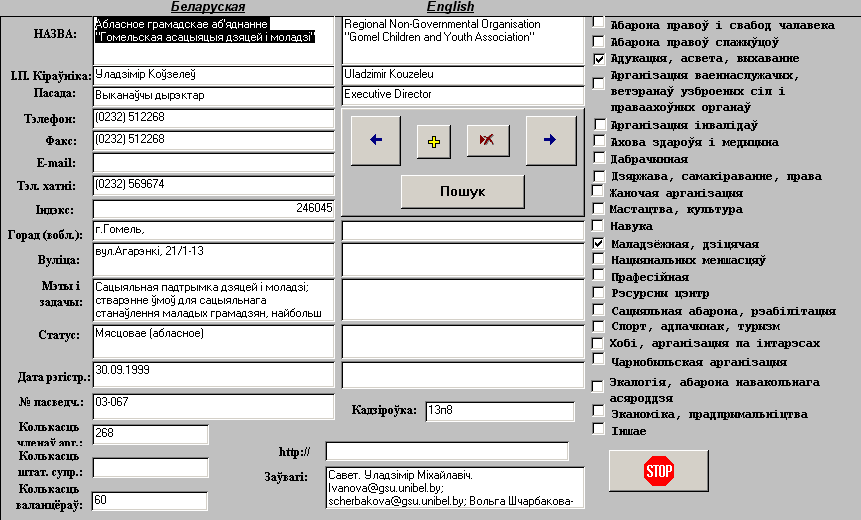
The information is in great demand among not only NGOs, but also representatives of Mass Media, foreign foundations and charitable organizations, state institutions, other interested entities and persons. Every year some new databases are added to a series of UWB information databases developed earlier. Databases of Belarusian NGOs, Legal Regulations of NGO activity, Foreign grantmakers supporting civil initiatives in Belarus, Press monitoring have been in use since 1996, while Database of Belarusian NGO Periodicals and Database of Volunteers — since 1999.All UWB's databases have been supplemented and updated permanently, they are open to public use in the Center. Most of the requests for data search come over the phone.
Precise and complete data were obtained thanks to close contacts and productive cooperation with numerous NGOs, Belarusian Association of Resource Centers, analytical and research centers catering to non-profit initiatives, mass media, national and local bodies, Ministry of Justice and departments of public associations of local executive committees, grantmaking organizations having their representation in Belarus.
Along with the special focus on the advancement of the existing electronic resources and further development of new ones, UWB strives not to overlook the needs of those organizations that have no access to Internet or cannot regularly visit our office in Minsk. Meeting their needs and requests we make our annual/biannual publications of the most requested databases in the form of directories and handbooks.
Database of Belarusian NGOs (electronic and print versions)
features information about 2 858 NGOs including organizations' official name, field of activity, date of registration, contact person, field of activity, date of registration, contact person number of NGO members, staff members, volunteers. Database includes NGOs that have been registered and re-registered in accordance with the Decree of the President of Belarus "On Certain Measures Regulating Activities of Political Parties, Trade Unions, and Other Non-Governmental Organisations" of January 26, 1999 (including amendments introduced by Decree 26 of July 13, 1999).
Database of Civil Initiatives
provides information on 758 non-registered public organizations. The database includes information about organizations' name, field of activity and contact person. This database is formed in collaboration with the Belarusian Association of Resource Centers, and this interaction is mutually beneficial for both of the organizations, UWB and BARC. The corporate work promotes exchanging timely information and updating the Database. The database is necessary and helpful to recruit representatives of civil initiatives for the implementation of UWB and BARC's programs.
Database of Grantmakers.
Gathering information for the third edition of Donors Directory, we worked out a new version of database. Questionnaires were sent to all grant-making agencies. Received information was inserted into the Foreign Foundations Database. It includes the following data elements:
- Name of Foundation;
- Address (Headquarters, Regional Offices);
- Telephone, fax, e-mail, web-site;
- Contact person;
- Fields of interest;
- Types of support;
- Limitations;
- Financial data;
- Application information.
Database of Grantmakers provides comprehensive information about 340 grantmaking organizations supporting non-commercial initiatives and individuals in Belarus. Detailed information on the types of assistance provided and mechanisms of applying for relevant support is listed in the data base records. UWB's customers could retrieve necessary information using special coding.
Belarusian NGO Periodicals Database.
This Database covers information about 377 periodicals of Belarusian non-governmental organization. The database involves information bulletins, newspapers, newsletters, magazines, and journals published by Belarusian NGOs and available at UWB's library. Parameters of the database include name, type of periodical, date of establishing, founder, editor-in-chief, circulation, language of publication, subject, mailing address, fax and telephone numbers, e-mail address, web-site. This database was started to meet the needs of those organizations and individuals, which were interested in the non-profit publications, their major audience, topics under discussion, etc.
JSIS 2000 Normative and Legal Database.
It presents national laws, edicts, resolutions and local enactments featuring legal framework for the non-profit community. Weekly update of the legal database made it one of the most comprehensive reference sources of the kind. It includes the following sections: current legislation of the Republic of Belarus, international treaties and agreements, legal terminology, publications of the journal "Taxation Review", court cases, statistical data, legal papers of local authorities. Search can be conducted using properties, classificator, key word, source of information, document status, context, etc.
Database of Press Monitoring Project
numbers 62 769 records featuring mass media publications on the third sector activity and related information. Though being a rather time-consuming initiative, press monitoring database update is still considered an important and worthy piece of work. With the current subscription to 24 national and regional periodicals we processed versatile mass media materials. With the specific requests coming we made special selections of publications featuring different field of NGO's activity.
NGO Glossary (database of NGO basic terms and concepts).
A newly developed database of terms common for the public sector will be permanently updated. This resource will be helpful for training courses held by the Center. Furthermore, it was used to compile NGO Basic Terms Encyclopedia, which came out in 2002.
Data base of Belarusian NGO Resource Centers.
Database of NGO Resource Centers comprises reference and contact information about Minsk-based and regional Centers as well as information about their activities, including key areas of activity, current and previous projects, regular kinds of services, periodicals, publications, etc.
All databases are regularly updated and open to public use in the Center.
|